7,000 fans filled the stands of the JNA Stadium in Belgrade on the evening of 9 May 1991. It was the final match of the Marshall Tito Cup, Yugoslavia’s premier cup competition, to be contested between Crvena zvezda (Red Star) from Belgrade and Hajduk from Split, Croatia.
It was well-anticipated that the match would be a tense affair. The decade before had seen ethnic tensions in Yugoslavia increase to a point of no return. Just a week before the final match, 13 people (12 of them Croats) had been killed in the Serb-majority village of Borovo Selo near Vukovar town at the Serbia-Croatia border in clashes triggered by Croat policemen hoisting the Croatian flag in the village. Croatian fans were not able to travel to Belgrade due to the massive risk involved, and only 2 fans from Split showed up on 9 May in Belgrade, unfurling a large Croatian flag while the police tried to prevent them from being attacked by the Serbs. Both of them would be taken out of the stadium 40 minutes before the match ended by the police.
The risk was not just of spontaneous crowd violence in a stadium. It was especially high because many of the most popular football teams in Yugoslavia had their dedicated, organised groups of supporters called ultras. During this period of high turbulence, these ultra supporters had acquired clear ethno-nationalistic identities. Red Star Belgrade had the infamous Delije, led at this time by Serbian warlord Željko Ražnatović (Arkan), a large number of whose members would go on to join the paramilitary group Arkan’s Tigers and commit warcrimes in the Yugoslav wars. Dinamo Zagreb, the club representing the Croatian capital, had the Bad Blue Boys, whose members organised into the Croatian National Guard. Partizan Belgrade’s Grobari and Hajduk Split’s Torcida were equally violent and leaned towards their respective (Serb and Croat) nationalist identities. There had been violent incidents in the years leading up to 1991, with the most famous one being a brawl during a Dinamo Zagreb vs Red Star Belgrade match in Zagreb in May 1990. In October 1990 another match between Hajduk Split and Partizan Belgrade had to be abandoned due to riots breaking out in streets of Split outside the stadium.
Nationalistic chants and displays were very normal alongside offensive and threatening chants. Red Star, which had once been the team that united all of Yugoslavia, was now firmly a Serb nationalist symbol. Yet even in 1991 the Red Star team still consisted of players like Robert Prosinečki (Croat), Darko Pančev (Macedonian) and Refik Šabanadžović (Bosniak). Hajduk, meanwhile, had been founded out of the anti-fascist movement led by Josip Broz Tito in the 1940s. As such, socialism was a part of its identity before acquiring the Croat nationalist colour in late 1980s. Almost the entire Hajduk squad was made up of Croats.
With the background of the nationalist fanbases of football teams, past incidents in football matches, the organisation of the Delije in the Belgrade stadium, loud anti-Croatian chants, and the recent clash at Borovo, the final match kicked off. Hajduk players were wearing shirts of the Croatian flag colours and black arm-bands in honour of those killed at Borovo. They had also refused to sing the Yugoslav national anthem before the match.
On the Red Star team was 22-year-old midfielder Siniša Mihajlović, a native of Borovo who had a Serb father and a Croat mother. Due to this mixed heritage, Delije were hostile to him when he joined the club. However, he had begun to project an outspoken Serb nationalist public image and was now friends with many of the Delije’s leaders.
Red Star were actually experiencing one of their most memorable seasons on the field. They had the Yugoslav league in their hands and had reached the final of both the Marshall Tito Cup and the UEFA European Cup. The Belgrade team were eyeing a historic treble and the achievement of becoming the first ever team from Yugoslavia (and the second-ever from Eastern Europe/Balkans) to become European champions. All that stood in their way was Hajduk Split on that day and the French club Olympique Marseille later that month.
Over in the Hajduk team, there was 23-year-old defender Igor Štimac, a fierce Croat nationalist. The personal opinions of players are not that much of a big deal. These sentiments were everywhere in Yugoslavia. But what mattered here was that both Igor and Siniša were young, enthusiastic, aggressive “alpha-personalities” who publicly stressed their Croat and Serb identities respectively, although the latter was half-Croat.
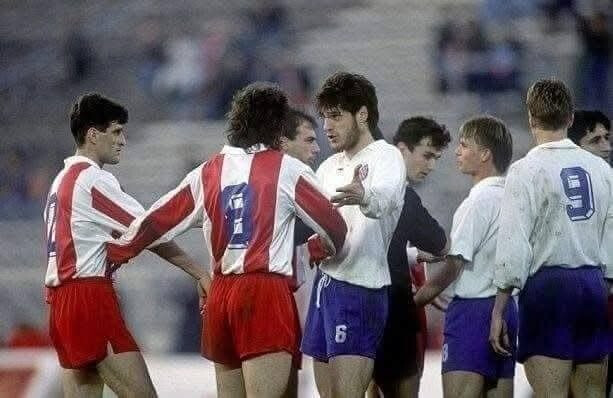
Igor and Siniša clashed repeatedly during the match. Even before the start of the match, Igor appeared to whisper something to Siniša, allegedly something provocative. In the first half of the match, Siniša repeatedly went out of his natural lane to chase Igor, engaging in tackles against him. The two hit each other with elbows and exchanged swear words, pulling each other’s shirts. The referee only warned them for now.
Red Star were naturally the favourites to win. They were having a phenomenal season and had several stars on their team. However, they were also eyeing the European Cup final just days later (which they would go on to win). Maybe due to this divided focus, or due to the tension in the match, or a combination of both - Red Star were failing to score despite creating much more chances. Hajduk defended their goal strongly.
In the 65th minute, Alen Bokšić scored a goal for Hajduk, in a massive upset against the Belgrade powerhouse. Igor Štimac intentionally celebrated with provocative gestures towards the Serb players, especially towards Siniša. Siniša, already frustrated due to Igor’s tackles against him, only got angrier.
In the 70th minute, Siniša slid into a hard two-footed tackle against Hajduk’s Grgica Kovač out of frustration. A confrontation broke out between the two teams. Hajduk’s Ante Miše, also a native of Borovo, grabbed Siniša’s hair. The two Borovo players were in direct confrontation. Other players also started fighting. Igor, seeing this, came to his teammates’ defense and confronted Siniša, shoving him. The two players then grabbed each other by their throats, which intensified the brawl further. Even the substitute players from the bench came on the ground to fight. The referee, in order to control the situation, showed red cards to both Igor and Siniša. Igor protested but the referee wouldn’t listen to anything.
Igor and Siniša had to walk out of the match. At this point, Igor turned to Siniša and (allegedly) told him, “I pray to God that our people kill all of your family in Borovo”.
Siniša turned violent once again and this time the stadium security had to intervene to separate them. The two loudly exchanged death threats and insults while walking off the pitch.
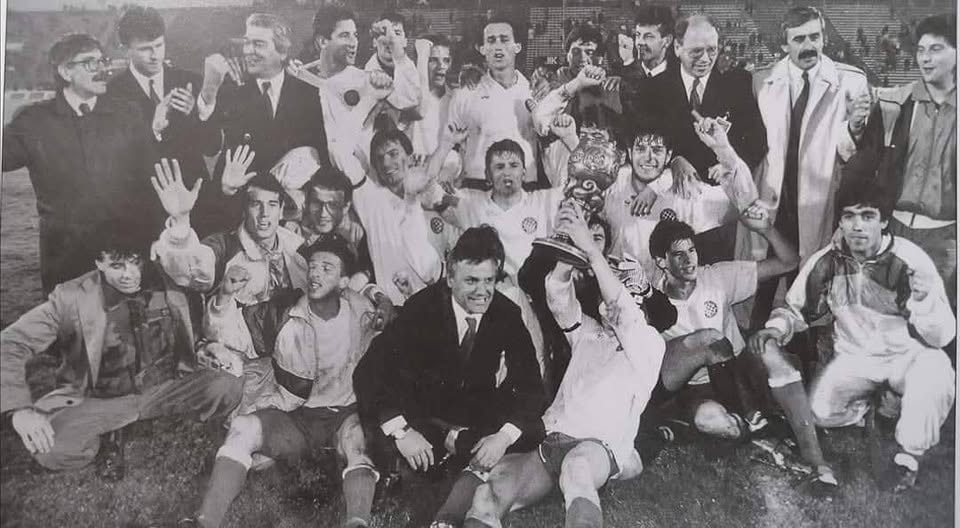
Red Star failed to score a goal in the match, and Hajduk Split won the final 1-0, taking the trophy to Split and burying it under their stadium, only digging it out in 2011. This was also the last ever complete football season in united Yugoslavia, as just a few days later Croatia and Slovenia held referendums and the very next month both of them declared independence.
Just a few months later, Siniša Mihajlović’s house in Borovo was destroyed during the Yugoslav wars and his family was evacuated to Belgrade with arrangements from the Delije leader and warlord Arkan himself. Siniša was also able to protect his Croat relatives due to ties with the Delije.
When Serbia and Croatia were drawn to face each other over two legs in 1999 for UEFA Euros 2000 qualifiers, Siniša Mihajlović was a regular member of the Serbian team (which still went by the name “Yugoslavia”) and Igor Štimac was the captain of the Croatian team. Croatia had just surprised the world by reaching the semifinals in the 1998 FIFA World Cup. In the two Croatia vs Serbia group matches in 1999, Siniša and Igor completely ignored each other, not even making eye contact. Both the matches ended in draws (0-0 and 2-2 in Belgrade and Zagreb respectively).
Siniša Mihajlović enjoyed a successful career as a coach after retirement. He served as the assistant manager of Inter Milan in Italy under famous coach Roberto Mancini. He also managed Bologna, Catania and Fiorentina in Italy.
Serbia failed to qualify for Euros 2012, leading the Serbian football association to fire the head coach and look for a new coach who could instill discipline into the squad. In May 2012, the association announced the appointment of Siniša Mihajlović as the head coach of the Serbian national team. Siniša made it mandatory for all players in the national team to sing the national anthem and refused to select players who did not pledge to do so (like the Bosniak-Muslim Adem Ljajić).
Meanwhile after coaching spells at Hajduk and Cibalia, Igor Štimac tried to enter Croatian football politics, contesting for President of the Croatian football association in 2010. Igor lost the election by one vote and refused to recognise the result, announcing the creation of his own separate governing body which led to him receiving a 2-year ban from all football-related activities. In 2012 the legendary former footballer Davor Šuker was chosen as the president of the football federation. He wanted to unify the two rival factions within the federation. Being heavily backed by Igor’s rivals who were in important positions, Davor decided to make up for it by offering Igor another important role. After Igor’s 2-year ban was over, the Croatian federation made a surprise decision and Igor Štimac was announced as the new head coach of the Croatian national football team in July 2012.
For the qualifiers for 2014 FIFA World Cup, Serbia and Croatia were coincidentally drawn in the same group. This meant two matches between them, each at Belgrade and Zagreb. Croatia were the favourites, with emerging talented players like Luka Modric leading the team. The narrative in media was set. The atmospheres were once again tense and the two men who had not spoken since 1991 prepared to face each other in 2 matches that would be treated as much more than just football games in both the countries. This was the first time ever that Croatia and Serbia faced each other in a football match (the 1999 matches were between Croatia and Yugoslavia). Both countries agreed to ban opposition fans from both the matches.
The first match on 22 March 2013 in Zagreb saw Croatia win 2-0. The Serbian team was escorted to and from the venue by Croatian military vehicles and the stadium in Zagreb was full of anti-Serb chants and displays. A banner carrying the words “VUKOVAR” was displayed by the crowd and chants like “Ubij, ubij, ubij Srbina” (Kill, Kill, Kill the Serbs) and the WW2-era fascist slogan “Za dom spremni” were chanted. However, the Serbian team applauded the Croatian anthem as a sign of respect while the Croatian fans boo’ed the Serbian anthem. Igor and Siniša shook hands and appeared to have forgiven each other.
The atmosphere at the second match in Belgrade on 6 September 2013 was no less hostile. The Serbian crowd boo’ed the Croatian anthem and chanted Ubij, zakolji, da Hrvat ne postoji!" (“Kill, slaughter, so that the Croat does not exist!”). This time the match was also tense. In the 80th minute, with the score tied 1-1, Serbia’s Miralem Sulejmani broke clear towards the Croatian goal. In a last-ditch attempt to stop him, Croatia’s Josip Šimunić brutally tackled him, committing an intentional foul. He was immediately shown a red card and sent off. However, his sacrifice proved to be worth it as the match ended 1-1. Serbia’s Nemanja Matić also received a red card in the later stages of the match. Croatia eventually qualified for the 2014 World Cup and Serbia missed out.
Igor and Siniša publicly acknowledged that they had forgiven each other and carried no bitterness. When the latter passed away in 2022 after battling leukemia, Igor said “We forgave each other a long time ago, may he rest in peace.”